
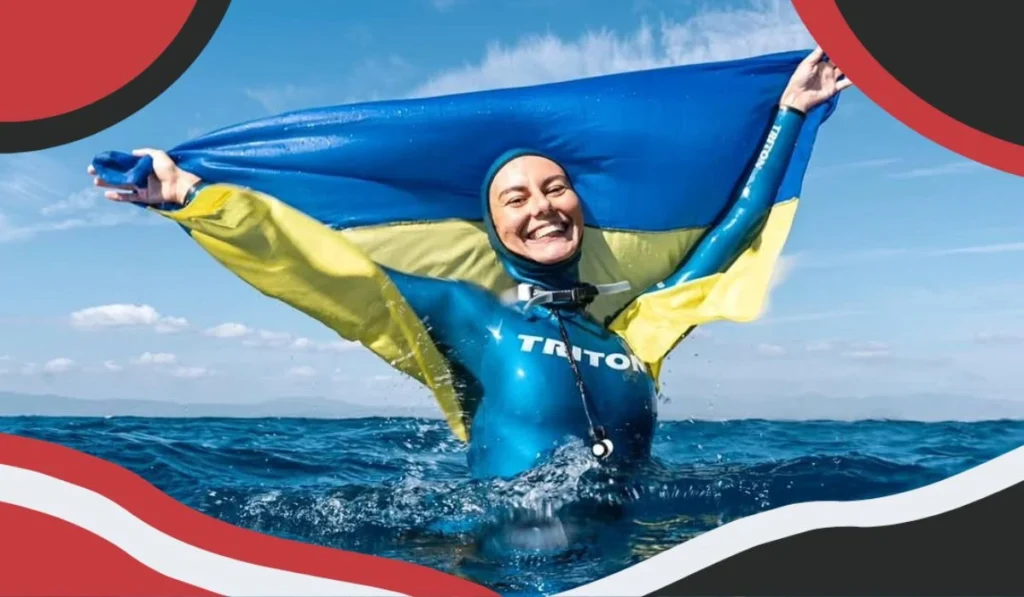
Ukrainian freediver Kateryna Sadurska has once again rewritten the record books, achieving a remarkable 86-meter dive without fins at the prestigious Blue Element competition in Dominica. This extraordinary feat marks her eighth world record in the Constant Weight No Fins (CNF) discipline and demonstrates her continued dominance in one of freediving’s most challenging categories.
A Dive Into History
On November 24, Sadurska completed her record-breaking dive in 3 minutes and 32 seconds, executing 10 strokes before entering freefall and 31 strokes during her ascent. The achievement represents a significant milestone in the sport of freediving, where athletes descend into ocean depths on a single breath without the assistance of fins or propulsion equipment.
What makes this accomplishment particularly striking is the technical precision required for CNF diving. Unlike other freediving disciplines where fins provide propulsion, CNF athletes must rely entirely on their swimming technique, body positioning, and mental fortitude. Sadurska described hearing whale clicks near the bottom of her dive, calling the moment “unforgettable”, adding a magical dimension to her already remarkable achievement.
The Journey to 86 Meters
Sadurska’s path to this record has been marked by consistent progression and unwavering determination. Her first AIDA CNF world record came in July 2023 when she reached 74 meters at the Vertical Blue competition. Since then, she has systematically pushed the boundaries of what’s possible in no-fins diving, breaking her own records multiple times.
The Blue Element competition in Dominica provided ideal conditions for record attempts, though the journey wasn’t without challenges. During an earlier attempt on November 25, heavy rain began falling just ten minutes before her scheduled dive, intensifying as the start approached. The adverse weather conditions forced Sadurska to make difficult decisions about safety and timing.
At a depth of 30 meters during that first attempt, she decided not to risk continuing and returned to the surface. This decision showcases the mature judgment required of elite freedivers, who must constantly balance ambition with safety considerations. The following day, with improved conditions, Sadurska successfully completed her record-breaking dive, demonstrating both patience and determination.
Understanding Constant Weight No Fins
For those unfamiliar with freediving disciplines, CNF represents the purest and most technically demanding form of depth diving. Athletes descend and ascend using only their swimming strokes, with no fins, propulsion devices, or pulling along a line. The discipline tests not only physical conditioning but also swimming efficiency, body awareness, and mental strength.
The physical demands are extraordinary. At 86 meters deep, water pressure is approximately 9.6 atmospheres—nearly 10 times the pressure at the surface. Divers must equalize this pressure in their ears and sinuses while conserving oxygen and maintaining efficient swimming form. The ascent is equally challenging, as athletes must overcome negative buoyancy in deeper waters while managing their remaining oxygen reserves.
Competition organizers noted the exceptional steadiness of Sadurska’s technique, particularly impressive given these extreme physical demands. Her ability to maintain composure and efficiency at such depths separates world-class performers from recreational freedivers.
A Champion’s Background
Sadurska’s success in freediving didn’t emerge from nowhere. She brings a rich athletic background that includes artistic swimming (formerly known as synchronized swimming), where she earned multiple medals at world championships. This foundation provided her with exceptional breath control, body awareness, and comfort in the water—all essential qualities for elite freediving.
The transition from artistic swimming to competitive freediving allowed Sadurska to channel her aquatic talents into a new challenge. Her systematic approach to training combines physical conditioning with mental preparation, recognizing that deep diving places immense stress on both body and mind.
In a previous interview, Sadurska emphasized the importance of comprehensive preparation. She explained that avoiding stress during deep dives requires not only physical readiness but also mental conditioning. This holistic approach has clearly paid dividends, as evidenced by her consistent record-breaking performances.
Diving for Ukraine
Beyond personal achievement, Sadurska’s accomplishments carry deep symbolic significance. Following her record, she dedicated her victory to Ukraine, its defenders, and everyone supporting the country during difficult times. As Ukraine’s sole representative at many international freediving competitions, she serves as an ambassador for her nation on the global stage.
Her presence at international competitions and continued success remind the world of Ukrainian resilience and excellence. In a time when her country faces significant challenges, Sadurska’s achievements provide inspiration and demonstrate the indomitable spirit of Ukrainian athletes.
The symbolic power of her dives extends beyond sports. Each record-breaking performance represents triumph over adversity, the pursuit of excellence despite obstacles, and the refusal to be defined by external circumstances—themes that resonate deeply with her fellow Ukrainians.
The Science of Freediving
Sadurska’s achievements push the boundaries of human physiology. At depths approaching 90 meters, the human body undergoes remarkable adaptations. The mammalian dive reflex triggers, redirecting blood flow from extremities to vital organs, slowing heart rate, and allowing blood vessels to constrict.
Lungs compress to a fraction of their normal volume as water pressure increases. At 86 meters, Sadurska’s lungs would compress to roughly one-tenth of their surface volume. The body compensates through blood shift, where blood moves into the thoracic cavity to prevent lung collapse—a physiological response shared with marine mammals.
Managing carbon dioxide buildup and oxygen depletion requires exceptional training. While most people associate breath-holding challenges with oxygen deprivation, carbon dioxide accumulation actually triggers the urge to breathe much earlier. Elite freedivers develop tolerance to elevated CO2 levels, allowing them to remain calm and efficient despite strong physiological signals urging them to return to the surface.
The CNF Evolution
Sadurska’s progression illustrates the rapid evolution of women’s CNF freediving. In just over two years, she has pushed the record from 74 meters to 86 meters—a 12-meter increase representing a 16% improvement. This progression reflects not only individual athleticism but also advances in training methodologies, safety protocols, and understanding of human capabilities.
The sport has gained increasing recognition worldwide, with competitions attracting both elite athletes and growing audiences. Events like Blue Element in Dominica and Vertical Blue in the Bahamas have become prestigious fixtures on the international freediving calendar, drawing competitors from around the globe.
Safety remains paramount in these competitions. Each dive involves extensive safety protocols, including support divers stationed at various depths, medical personnel on standby, and strict performance monitoring. The freediving community maintains rigorous standards, recognizing that pushing human limits must be balanced with responsibility and caution.
Looking Ahead
With this latest record, Sadurska has established herself as the undisputed leader in women’s CNF freediving. Her consistent performance across multiple competitions in 2024—including gold medals at both AIDA and CMAS World Championships—demonstrates not just peak performance but sustained excellence.
The question now becomes: how much deeper can human athletes dive without fins? While Sadurska has pushed well beyond 80 meters, physiological limits do exist. However, the history of freediving suggests that perceived limits often prove temporary as athletes develop new techniques and training methods.
For Sadurska, this record likely represents another milestone in an ongoing journey rather than a final destination. Elite athletes of her caliber typically view each achievement as a stepping stone to the next challenge. Her systematic progression suggests she may have more records in her future.
Inspiration for the Next Generation
Beyond the numbers, Sadurska’s achievements inspire aspiring freedivers worldwide. She demonstrates that with proper training, dedication, and mental preparation, humans can achieve seemingly impossible feats. Her success encourages others to explore their own potential, whether in competitive freediving or other challenging pursuits.
The technical mastery required for CNF diving also appeals to those seeking a pure test of swimming efficiency and body control. Unlike disciplines using fins or other equipment, CNF represents the most fundamental interaction between human and ocean—one breath, one body, one dive.
Conclusion
Kateryna Sadurska’s 86-meter CNF dive at Blue Element stands as a testament to human potential, athletic excellence, and unwavering determination. She has now set eight world records and pushed the CNF discipline forward by ten meters since 2023, establishing a legacy that will inspire freedivers for years to come.
As she continues representing Ukraine on the international stage, Sadurska embodies both athletic achievement and national pride. Her journey from artistic swimmer to world record-holding freediver illustrates how dedication, proper preparation, and mental fortitude can produce extraordinary results.
The freediving community now watches with anticipation to see where Sadurska will take the sport next. If her recent trajectory indicates anything, the 86-meter record may simply be another chapter in an ongoing story of pushing human limits deeper into the ocean’s mysterious depths.