
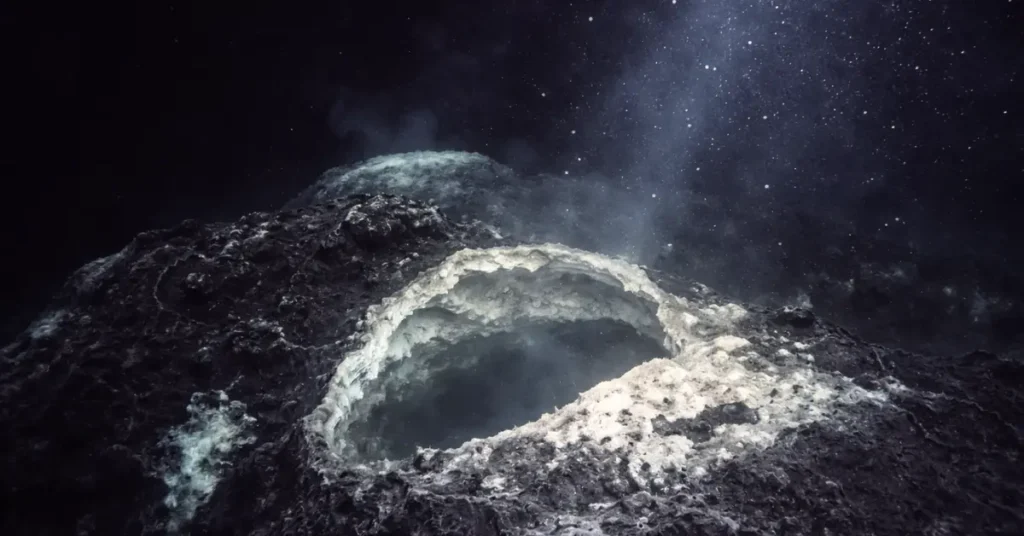
Underwater volcanoes dominate Earth’s volcanic activity, yet they remain among the least observed natural systems. Scientists estimate that more than two-thirds of all magma erupts beneath the ocean, shaping the seafloor, influencing marine ecosystems, and occasionally triggering global-scale hazards. Despite this, only a small fraction of submarine eruptions are directly monitored.
This knowledge gap has made it difficult to assess the real risks posed by underwater volcanic activity. Recent research led by the National Oceanography Centre and published in Nature Communications is helping close that gap. By studying deep-sea sediment deposits, scientists are now able to reconstruct how explosive submarine eruptions behave and how far their effects can spread.
Why Submarine Volcanoes Are So Hard to Observe
Unlike land volcanoes, underwater eruptions occur in environments that are difficult to access, often at great depths and far from monitoring infrastructure. This makes direct observation rare and incomplete. Even when eruptions are detected, the ocean quickly disperses ash and volcanic material, erasing clear surface evidence.
Another challenge is that historical records are extremely limited. Without continuous monitoring, scientists must rely on indirect geological evidence to reconstruct past activity. This is where seafloor sediments become crucial, as they preserve the physical “imprint” of past eruptions.
New Discovery: Sedimentary Fingerprints of Explosive Eruptions
The breakthrough study reveals that explosive submarine volcanic eruptions leave behind distinct and recognizable patterns in seafloor sediments. These patterns act like geological fingerprints, allowing scientists to identify past eruptions even when no one witnessed them.
Researchers found that these deposits record not just the presence of volcanic activity, but also how the eruption behaved dynamically. Instead of simple directional flow, the sediment structures show complex dispersal patterns that reflect powerful underwater density currents.
Key characteristics of these deposits include:
- Sediment spread in multiple directions rather than a single flow path
- Layered deposits indicating repeated eruptive pulses over time
- Long-distance transport of volcanic material across vast seafloor regions
These features help distinguish explosive submarine eruptions from other marine processes such as landslides or collapsing volcanic islands.
Case Study: The 2022 Tonga Eruption
A major reference point for this research is the eruption of the Hunga Tonga–Hunga Haʻapai volcanic eruption. This event provided one of the most detailed modern examples of how underwater volcanic systems behave during extreme activity.
The eruption released massive amounts of volcanic material into the ocean in a very short time. This material generated powerful underwater density currents that traveled over 100 kilometers across the seafloor, reshaping sediment layers and disrupting marine environments far from the eruption site.
Unlike many terrestrial eruptions, this event demonstrated how rapidly submarine volcanic systems can redistribute material across entire ocean basins, making them significant geological hazards rather than isolated local events.
How Underwater Eruption Flows Behave
One of the most important findings from the study is that explosive submarine eruptions generate flows that behave very differently from typical underwater sediment movements.
Instead of moving in a single direction like gravity-driven landslides, these flows expand outward in multiple directions due to explosive energy release beneath the water column. They can also persist for extended periods, transporting dense volcanic material across large areas of the seafloor.
Key flow behaviors observed include:
- Multidirectional spreading of sediment flows
- Sustained movement driven by continuous eruptive pulses
- Strong interaction with underwater terrain such as ridges and trenches
These dynamics significantly increase the potential hazard zone around submarine volcanoes.
Why This Research Matters for Global Infrastructure
Submarine volcanic activity is not just a geological curiosity-it poses real risks to modern infrastructure and ecosystems. One of the most critical concerns is damage to submarine communication cables, which carry the vast majority of global internet traffic.
These cables lie directly on the seafloor and are vulnerable to disruption from volcanic density currents, which can bury, fracture, or displace them over large distances. An event like the Tonga eruption shows how a single submarine eruption could potentially impact communication networks across entire regions.
Beyond infrastructure, underwater eruptions also affect marine ecosystems by rapidly altering habitats and depositing large volumes of sediment that can smother biological communities.
From Observation to Prediction: A Shift in Volcanology
A major outcome of this research is the shift from reactive observation to predictive understanding. Instead of studying eruptions only after they occur, scientists can now use sedimentary evidence to identify volcanoes that have produced large explosive events in the past.
This allows researchers to assess which volcanic systems are capable of generating high-energy flows and which regions may be at risk in the future. Over time, this approach could significantly improve hazard forecasting models for submarine volcanic activity.
Dr. Mike Clare and colleagues at the National Oceanography Centre emphasize that linking eruption processes directly to their sedimentary records is a key step toward proactive risk management in marine environments.
Reconstructing Earth’s Hidden Volcanic History
Seafloor sediments act as a natural archive of volcanic activity, preserving layers of material deposited during past eruptions. By analyzing these layers, scientists can reconstruct eruption frequency, intensity, and dispersal patterns.
This approach is especially valuable in regions where no historical records exist. Even ancient eruptions that occurred thousands of years ago can sometimes be identified through their sediment signatures.
Over time, this method is helping build a clearer picture of how often explosive submarine eruptions occur and how far their effects extend.
Future Research and Monitoring Needs
Despite the progress made, submarine volcanology remains a developing field. Large areas of the ocean floor are still unmapped, and many active volcanic systems remain unmonitored. Improving this situation will require a combination of technologies and scientific approaches.
Future research is likely to focus on better deep-sea sensor networks, improved mapping of sediment layers, and advanced computer models that simulate underwater eruption dynamics. Autonomous underwater vehicles and long-term monitoring stations will also play a key role in capturing real-time data from active submarine volcanoes.
Conclusion: Understanding the Ocean’s Most Powerful Hidden Forces
The latest discoveries from the National Oceanography Centre mark a turning point in how scientists understand underwater volcanic activity. By decoding the sedimentary records left behind by explosive eruptions, researchers are uncovering a hidden history of powerful geological events that have shaped the seafloor for millions of years.
More importantly, this knowledge is beginning to transform how we assess risk in the deep ocean. As global infrastructure increasingly depends on the seafloor, understanding these hidden volcanic systems is no longer just an academic pursuit-it is essential for protecting communication networks, ecosystems, and coastal regions in the future.